Running a long-term tabletop role-playing game campaign is not just about having a good story idea. Plenty of campaigns begin with a strong premise, a memorable villain, or a fascinating setting, only to lose their shape over time. The world starts to feel loose. Important moments stop mattering. Rules bend whenever it is convenient. Characters blur into simple archetypes. What once felt alive begins to feel hollow.
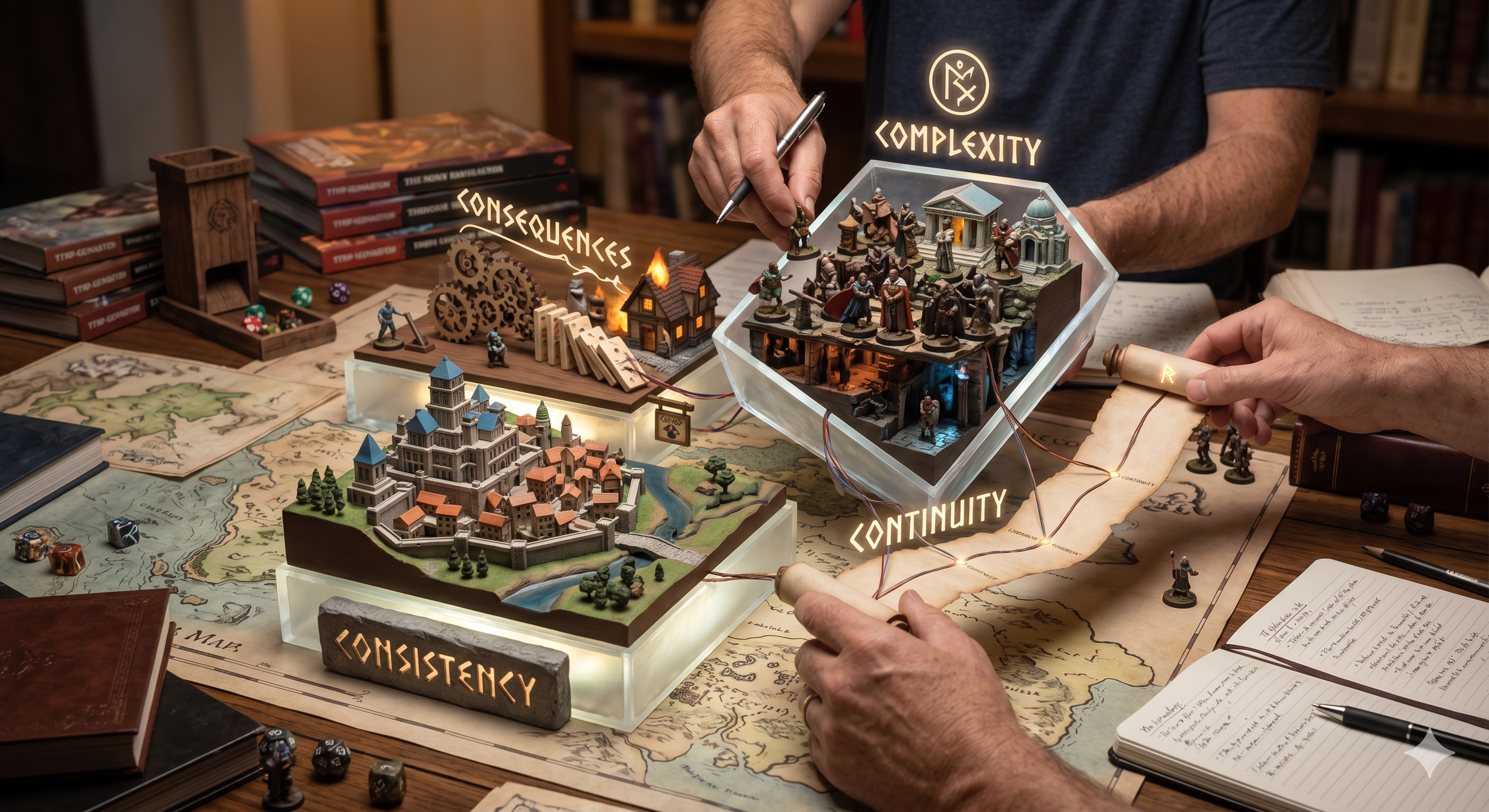
What gives a long-term campaign weight is not only creativity, but structure. More specifically, it is the structure that allows the world to feel believable, responsive, and lived in. For me, one of the clearest ways to think about this is through what I call the 4Cs: Consistency, Consequences, Continuity, and Complexity.
These four elements are what help transform a campaign from a series of disconnected adventures into a world that players can truly invest in. They give the game depth. They help players take the setting seriously. And most importantly, they make the campaign feel like something that exists beyond the immediate needs of the current session.
Consistency
Consistency is where that trust begins.
A campaign world needs internal logic. If you establish that a magic system works in a certain way, that logic should continue to hold unless there is a very clear reason for it to change. If resurrection is rare and dangerous, it should not suddenly become casual because the plot would be easier that way. If nobles have political power, then that power should matter when the players cross them. If a city is defined as paranoid, militarized, and tightly controlled, then the players should feel that reality whenever they operate there.
Consistency is what teaches players how to understand the world. It creates confidence that their decisions are happening in a stable environment rather than in a reality that shifts whenever the Game Master needs a shortcut. Once players begin to feel that rules, tone, and world logic are flexible only when convenient, immersion starts to crack. They stop interacting with the world as a real place and start treating it like a stage set.
That does not mean nothing can ever change. A world can evolve. Systems can be challenged. New discoveries can reveal that previous assumptions were incomplete. But those shifts need to feel earned. They need to emerge from the fiction rather than from convenience. A world that is consistent does not have to be static. It simply has to be honest with itself.
Consequences
If consistency builds trust, consequences are what make player choice matter.
One of the fastest ways to flatten a campaign is to let player actions vanish into the air. If the party insults a mayor, burns down a tavern, betrays a guild, or spares a dangerous enemy, those actions should not disappear the moment the session ends. A living world reacts. It remembers. It resists. It adapts.
Consequences are what turn action into meaning. They tell the players that their choices are not just flavor, but forces that shape the campaign. If the group antagonizes the mayor of a town, perhaps that mayor does not simply sulk offscreen. Perhaps he sends warnings ahead to neighboring settlements. Perhaps the town guard becomes less cooperative. Perhaps merchants quietly refuse service. Perhaps local rumors begin to paint the party as dangerous troublemakers. Suddenly, one heated moment has changed the social landscape of the story.
Consequences do not always need to be punitive. Good actions should matter too. Saving a village may earn trust, but that trust might also come with requests for help, awkward loyalty, or political expectations. Sparing an enemy might create a future ally, or a future disaster. The point is not that every choice must explode dramatically, but that choices should ripple outward in believable ways. Once players realize that the world responds seriously to what they do, they begin to take their own decisions more seriously as well.
That naturally leads into continuity.
Continuity
Continuity is what allows the consequences of one session to still matter in the next. It is the thread that keeps the campaign from feeling episodic and forgetful. In a strong long-term game, the world does not reset every week. Events carry forward. Decisions linger. Absences are felt. Names, places, promises, and mistakes remain part of the living memory of the story.
This can be as large as the death of a major non-player character changing the entire political balance of a region, or as small as remembering that a frightened stable boy the party once comforted now recognizes them months later. Continuity tells players that the campaign has memory. It reassures them that what happened before still exists, still counts, and still has the power to shape what happens next.
Without continuity, even meaningful consequences lose strength. A campaign can claim that actions matter, but if the world never carries them forward, that claim rings hollow. Players may save a city one week and find that the city behaves as though nothing happened the next. They may kill a key faction leader and discover that the faction somehow continues untouched. They may swear loyalty, make enemies, break laws, or alter history, only for the game to quietly move on as though none of it left a mark.
Continuity is what prevents that emptiness. It is the discipline of remembering. It is what makes the campaign feel cumulative rather than disposable.
And then there is complexity, which is what gives all of the above texture.
Complexity
A campaign can be consistent, reactive, and continuous, and still feel shallow if everything in it is too simple. Complexity is what prevents the world from becoming flat, predictable, or morally lifeless. It is the understanding that the world is rarely divided into pure heroes and pure villains, obvious good choices and obvious bad ones. People have motives. Institutions have contradictions. The truth often comes tangled in self-interest, fear, survival, grief, or ideology.
Complexity means refusing to reduce every problem to a neat binary. It means letting villains believe in what they are doing. It means letting kind people cause harm and cruel people occasionally do something generous. It means allowing the party to face dilemmas where there may be no clean answer, only costs they are more or less willing to bear.
This does not mean every story must be bleak or cynical. Moral clarity has its place. Sometimes evil really is evil, and sometimes heroism should shine brightly. But a world with no shades of gray becomes thin very quickly. When every noble is corrupt, every rebel is noble, every monster is monstrous, and every choice has an obvious correct answer, players stop engaging deeply. They start solving the campaign instead of inhabiting it.
Complexity invites players to think. It gives them room to debate, to doubt, to hesitate, and to define themselves through the choices they make. It also makes non-player characters feel more human. A villain driven by grief, pride, desperation, or genuine belief is always more compelling than one who exists only to be evil on cue. A town elder who is stubborn, loving, prejudiced, and protective all at once feels more real than one who is simply “the good NPC” or “the bad NPC.”
Conclusion
What makes the 4Cs powerful is that they are not separate pillars standing far apart from one another. They reinforce each other constantly.
Consistency makes consequences believable. If the world has a stable logic, then its reactions feel earned. Consequences give continuity substance. If actions matter, then there is something worth carrying forward from session to session. Continuity strengthens complexity, because once the world remembers, people and situations can evolve in layered and realistic ways. Complexity, in turn, makes the consequences of player action feel less mechanical and more human.
Taken together, the 4Cs create a campaign world that feels alive.
This is especially important in long-term play, because long-term campaigns live and die on player investment. In a one-shot, players can enjoy spectacle, improvisation, and chaos without needing every thread to hold. But over months or years of play, players begin to test the world more deeply. They remember what was said. They notice contradictions. They look for patterns. They care about unresolved actions and unanswered questions. They want proof that the campaign is not just moving around them, but growing with them.
The 4Cs help provide that proof.
They tell the players that this world has rules, memory, and depth. They show that choices matter, not because the GM says they do, but because the campaign itself demonstrates it. They create an environment where players can become emotionally invested, because the setting feels sturdy enough to support that investment.
That does not mean a GM must become some perfect keeper of a flawless simulation. Mistakes happen. People forget details. Campaigns drift. Improvisation is part of the magic of tabletop gaming. But having the 4Cs in mind gives you something to return to. When you are unsure how to handle a decision, a consequence, or a character arc, these four principles help ground the answer.
Ask yourself: is this consistent with the world? What are the consequences? How does this continue what has already happened? What complexity can make this richer and more human?
Those questions alone can strengthen a campaign immensely.
At the end of the day, a long-term campaign is not remembered only for its boss fights, clever puzzles, or dramatic reveals. It is remembered for how real it felt. It is remembered for the way the world responded, the way choices lingered, and the way people and places seemed to have lives of their own.
That is the power of the 4Cs.
They do not just make a campaign more organized. They make it feel alive.