Running a one-shot is an art.
You are working with limited time, new or unfamiliar players, and a story that needs to feel complete within a single session. Unlike long campaigns, there is no room for slow buildup. Every moment needs to serve a purpose.
Over time, I have developed a structure that consistently delivers engaging, beginner-friendly, and satisfying one-shot experiences. This template is not meant to limit creativity. It exists to give your session a strong foundation so you can focus on what matters most, the players and their experience.
🧭 The Structure at a Glance
A good one-shot should feel like a complete story arc:
- A clear beginning
- Meaningful middle conflicts
- A memorable ending
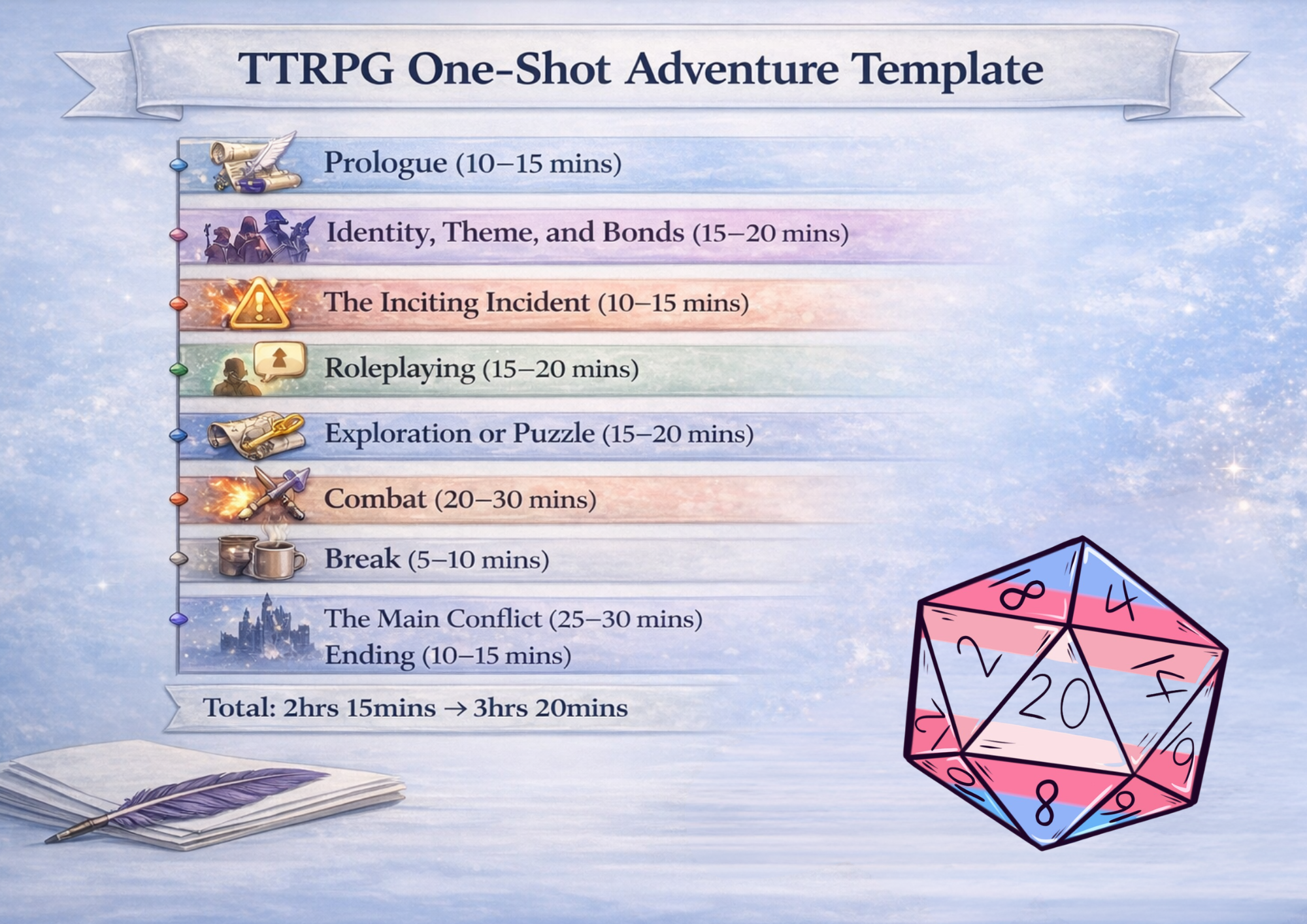
This template typically runs between 2 hours 15 minutes to 3 hours 20 minutes, making it ideal for events, workshops, or casual sessions.
🌅 Prologue (10 to 15 mins)
This is where everything begins.
Keep it short and focused:
- Introduce the system and only what players need to know
- Explain the setting in broad strokes
- Set expectations for the adventure
The goal is not to overwhelm players with information. The goal is to get them comfortable enough to start playing quickly.
🧑🤝🧑 Scene 1: Identity, Theme, and Bonds (15 to 20 mins)
This is one of the most important parts of the session.
Give players time to:
- Introduce who their characters are
- Share their themes, personalities, or quirks
- Establish relationships with one another
When players understand how they are connected, the story becomes immediately more engaging. This scene turns a group of individuals into a party with shared purpose.
⚡ Scene 2: The Inciting Incident (10 to 15 mins)
This is where the story begins to move.
Something happens that:
- Demands action
- Creates urgency
- Pulls the characters into the main plot
Keep it clear and direct. Players should know what they need to do next without confusion or hesitation.
🔥 Scenes 3 to 5: The Core Conflicts (1 to 1.5 hours)
This is the heart of your one-shot. Each conflict should feel different and give players a chance to engage in different ways.
🎭 Conflict 1: Roleplaying
This scene focuses on interaction and character expression. Players might negotiate with an NPC, gather information through conversation, or deal with a tense social situation. This is where personalities shine and where players begin to feel ownership over their characters. A good roleplaying conflict should reward creativity, allow for different approaches, and create emotional investment in what happens next.
🧩 Conflict 2: Exploration or Puzzle
This scene shifts the focus toward problem-solving and discovery. Players might investigate a location, piece together clues, or overcome a challenge that requires teamwork and thinking rather than combat. This is a great moment to slow things down slightly and let players engage with the world. It gives them a sense of progression and helps build anticipation for what is coming.
⚔️ Conflict 3: Combat
This is where tension peaks within the middle section of the session. The combat should feel meaningful, not just something included for the sake of it. It could be a dangerous encounter, a defensive struggle, or a fight tied directly to the story. The goal is to challenge the players while reinforcing the stakes. Even a simple combat can feel exciting if it is connected to the narrative.
☕ Break (5 to 10 mins)
Take a short break after Conflict 1 or Conflict 2.
This allows players to reset, grab a drink, and return with fresh energy. It also gives you a moment to prepare the next part of the session. A well-timed break helps maintain pacing and prevents fatigue.
⏳ Scene 6: The GM Push (5 mins)
This is your moment to refocus the table.
Remind players:
- What is at stake
- Why it matters
- What happens if they fail
This scene builds urgency and ensures the final act feels focused and intentional.
🌪️ Scene 7: The Main Conflict (25 to 30 mins)
This is the climax of your one-shot.
Bring everything together and raise the stakes. Introduce a twist, a complication, or a final challenge that forces the players to act decisively. This moment should feel impactful, whether it is a dramatic battle, a difficult choice, or an unexpected reveal.
🌙 Scene 8: Ending (10 to 15 mins)
Every one-shot needs a satisfying conclusion.
You can wrap things up cleanly, show the consequences of the players’ actions, or leave a small hook for future stories. The important thing is that players feel their choices mattered.
💜 Why This Works
This structure works because it balances pacing, variety, and clarity.
Players always know what is happening, the session does not drag, and everyone gets a chance to engage in different ways. It is especially effective for beginner-friendly sessions and community events where time and energy are important.
🌱 Final Thoughts
A great one-shot is not about having the most complex story.
It is about creating moments for players to shine, keeping the session moving, and ending on something memorable.
Use this as a guide, adapt it to your style, and make it your own.
Because the best sessions are not just played. They are experienced together.
TTRPG One-Shot Adventure TemplatePrologue (10-15 mins)- Introduction to the System: Briefly explain the system used for this game. - Introduction to the Campaign Setting: Briefly explain the world and setting. - Introduction to the Adventure: Briefly explain what the adventure is about. Scene #1 (15-20 mins) - Identity, Theme, and Origins: Give the PCs a chance to explain and introduce their characters. - Bonds: Ask the PCs to explain how they are related. Scene #2 (10-15 mins) - Story Setup: Trigger for the main story to happen. Scenes #3, #4, #5 (1 hr - 1 hr 30 mins) - Conflict #1 Roleplaying. - Conflict #2: Exploration or Puzzle. - Conflict #3: Combat. Break: ( 5-10mins ) Take a 5-10 min break after Conflict #1 or Conflict #2. Scene #6 (5 mins) - GM Scene: Pause to explain the urgency of the task. Scene #7 (25-30mins) - Main Story Conflict: Introduce a possible twist. Scene #8 (10-15mins) - Ending: Provide a satisfying ending or create an interesting cliffhanger to make them want more. Total: 2hrs 15mins -> 3hrs 20 mins |