When introducing new players to Dungeons & Dragons, one of the biggest mistakes I see is this: People hand beginners the official character sheet and expect that to be enough. For experienced players, that sheet makes sense. It is a useful reference because they already understand what the numbers mean, where to look, and how the different parts connect. But for a brand new player, the default sheet often feels less like a game aid and more like paperwork. It assumes familiarity. And that is the problem.
The Default Sheet Is Designed for Players Who Already Know the Game
The official D&D character sheet is not actually a teaching tool.
It is a storage tool.
It is designed to hold information efficiently for people who already know:
- what an ability modifier is
- how proficiency works
- what a saving throw is
- how spellcasting is structured
- how to interpret attacks, actions, and resources
A beginner does not know any of this yet.
So when we put a default sheet in front of them during a demo, we are not making the game easier. We are asking them to decode a document while also trying to learn roleplay, dice rolling, turn order, and the tone of the game itself.
That is far too much cognitive load for a first session.
A Demo Should Teach, Not Test
When someone joins a demo, they are not there to prove they can navigate a complex sheet.
They are there to discover whether the game is fun.
That means our materials should reduce friction as much as possible. The character sheet for a demo should guide the player toward action, not force them to hunt for meaning. A newcomer should be spending their energy imagining what their character does, not squinting at boxes and asking where to find their spell attack bonus.
A good demo sheet should answer questions before they are asked.
It should tell the player:
- what they can do
- when they can do it
- how to roll it
- and what it means in plain language
That is what makes a demo feel welcoming.
“Fire Bolt” Is Not Enough
One common example is spellcasting.
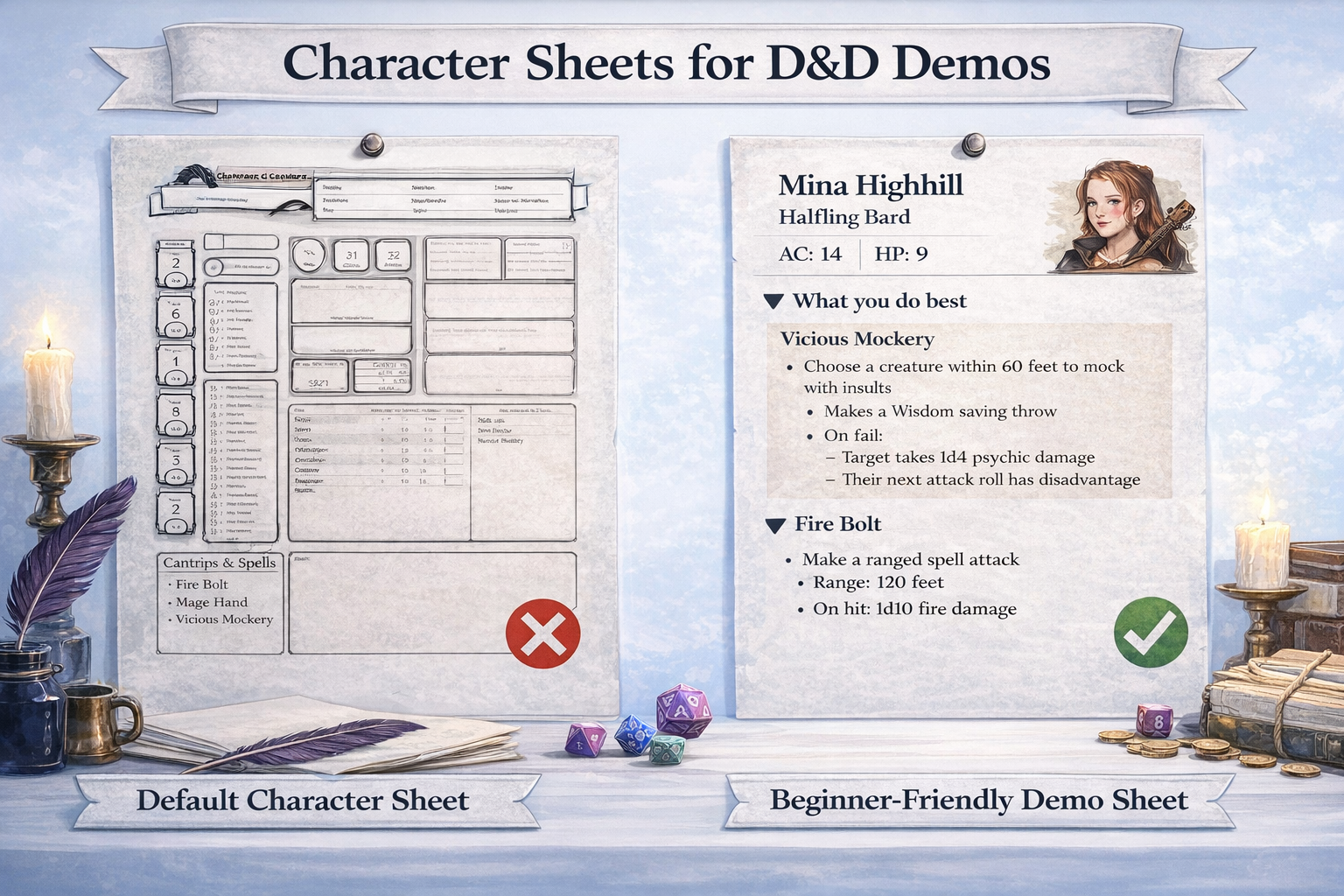
A demo sheet might list:
- Fire Bolt
- Vicious Mockery
- Mage Hand
That may be enough for an experienced player, because they already know to ask about range, damage, saving throws, casting time, and effects.
A beginner does not.
If you simply write “Fire Bolt” on the sheet, you are forcing the new player to ask follow-up questions or flip through rules text just to understand one of their most basic options. That interrupts flow and makes them feel like they are missing something important.
Instead, the sheet should include the full usable version of the spell, or at least a simplified play version.
For example:
Fire Bolt
Make a ranged spell attack.
Range: 120 feet
Hit: 1d10 fire damage
Or:
Vicious Mockery
Choose one creature you can see within 60 feet.
It makes a Wisdom saving throw.
If it fails, it takes 1d4 psychic damage and has disadvantage on its next attack.
Now the player can actually use the ability without needing a translator.
Another great alternative is to provide spell cards, ability cards, or quick-reference action cards. These make the game feel tactile, readable, and far less intimidating.
Beginners Should Not Feel Like They Are Filling Out Tax Forms
This is the feeling we need to avoid.
For many new players, the first experience of D&D is not excitement. It is confusion. They look at a dense official sheet full of boxes, labels, modifiers, and unexplained terms, and it feels like they are being handed a complicated form to process rather than a character to play.
That kills momentum before the adventure even starts.
A demo should feel inviting, playful, and immediate.
The player should be able to glance at their sheet and quickly understand:
- who they are
- what makes them cool
- what they can do on their turn
If the sheet creates stress, the sheet has failed.
Demo Sheets Should Be Built Around Play
A beginner-friendly demo character sheet should not try to preserve every part of the official format.
Instead, it should be built around actual play at the table.
That means prioritizing:
- clear actions
- simple attack instructions
- explained spells
- obvious modifiers
- brief descriptions of special abilities
- minimal clutter
For example, instead of showing a wall of statistics, you can organize a sheet into sections like:
What You Do Best
Sword attacks, spells, healing, sneaking, protecting allies
What to Roll
“Attack with sword: roll d20 + 5, damage 1d8 + 3”
Special Moves
Short, simple descriptions in plain English
Personality and Roleplay Hooks
A sentence or two to help them get into character
This kind of format teaches through use.
The Goal Is Confidence
A good demo does more than explain rules.
It builds confidence.
When a new player understands their options, they become more willing to engage. They ask questions, make bold choices, and start enjoying the game instead of worrying about getting it wrong.
That confidence is what turns curiosity into enthusiasm.
If someone leaves your demo thinking, “That was fun, I want to play again,” then you succeeded.
If they leave thinking, “That seemed complicated and stressful,” then even a great adventure may not save the experience.
Make It Easy for Them to Say Yes
Sometimes demo organizers take the easy route by using official sheets because they are already available.
That makes things easier for the GM.
But not for the player.
And demos should be designed for the player first.
If we want more people to enter the hobby, then we need to meet them where they are. We need to simplify without patronizing. We need to explain without overwhelming. We need to guide without making them feel lost.
The easier it is for someone to understand their character, the easier it is for them to fall in love with the game.
Conclusion
The official D&D character sheet is fine for regular play once someone already knows the system.
But for demos, we should do better.
A beginner-friendly demo sheet should teach, guide, and invite action. It should include usable spell descriptions, clear attacks, simple explanations, and a layout built around real play. New players should feel like they are stepping into an adventure, not wrestling with a form.
Because the goal of a demo is not to show how complicated the game can be.
It is to show how fun it can be.
Example of Lord of the Rings 5E pregens
http://paradisium.online/storage/media/SGHwo6aYFMHgsMRSeEj37SLjUpHXkSlYHbAGgTpc.pdf